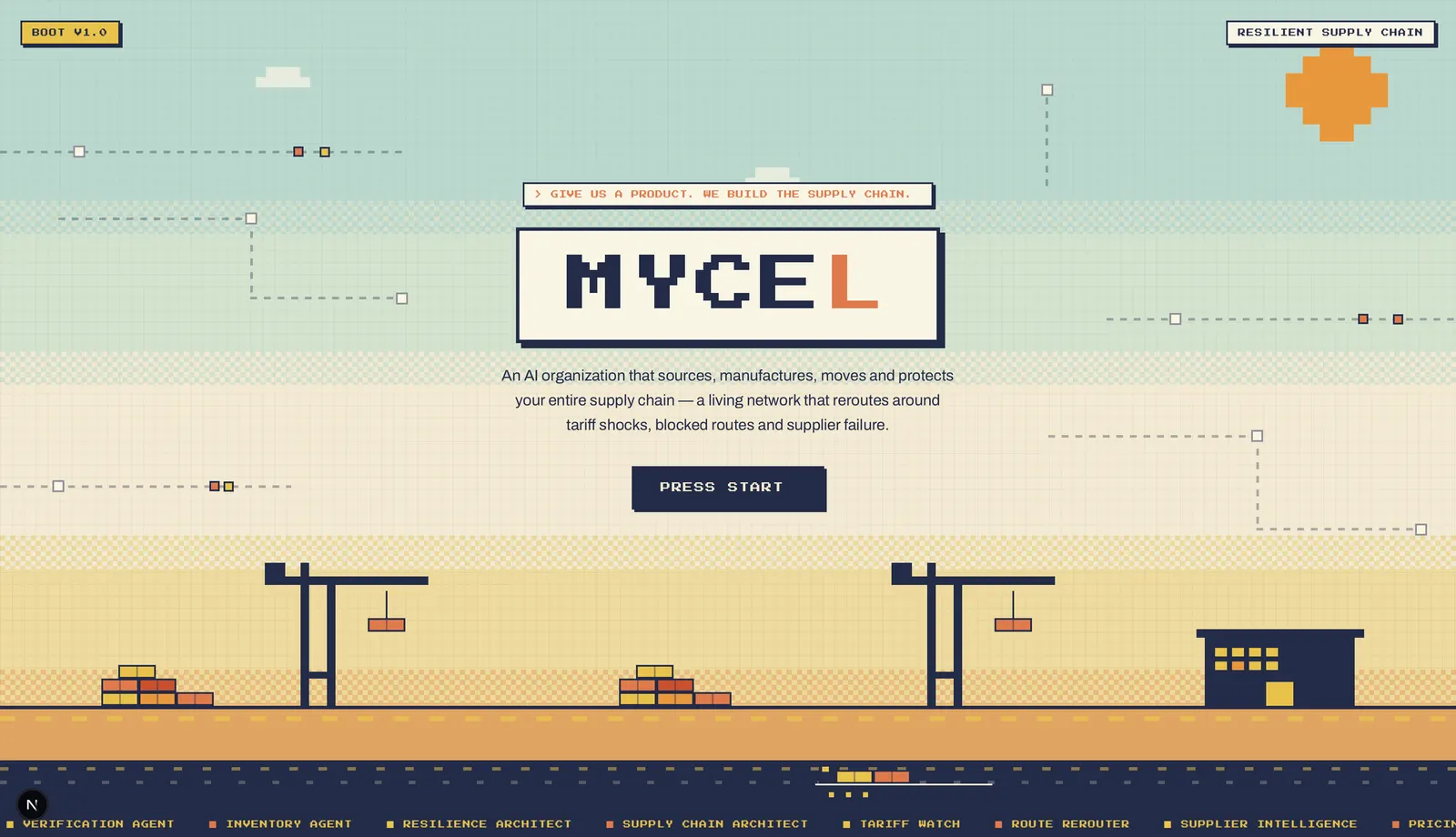
Give it a product. An organisation of 22 AI agents designs the supply chain, then keeps watching it.
- role
- Team Evolve AI
- status
- Hackathon build
- when
- AUTOMATE-INDIA, Sep 2026
- ownership
- Team project
Who did what. Built by team Evolve AI for the AUTOMATE-INDIA hackathon. Everything described below is the team's system; my individual part will be listed here once confirmed.
Overview
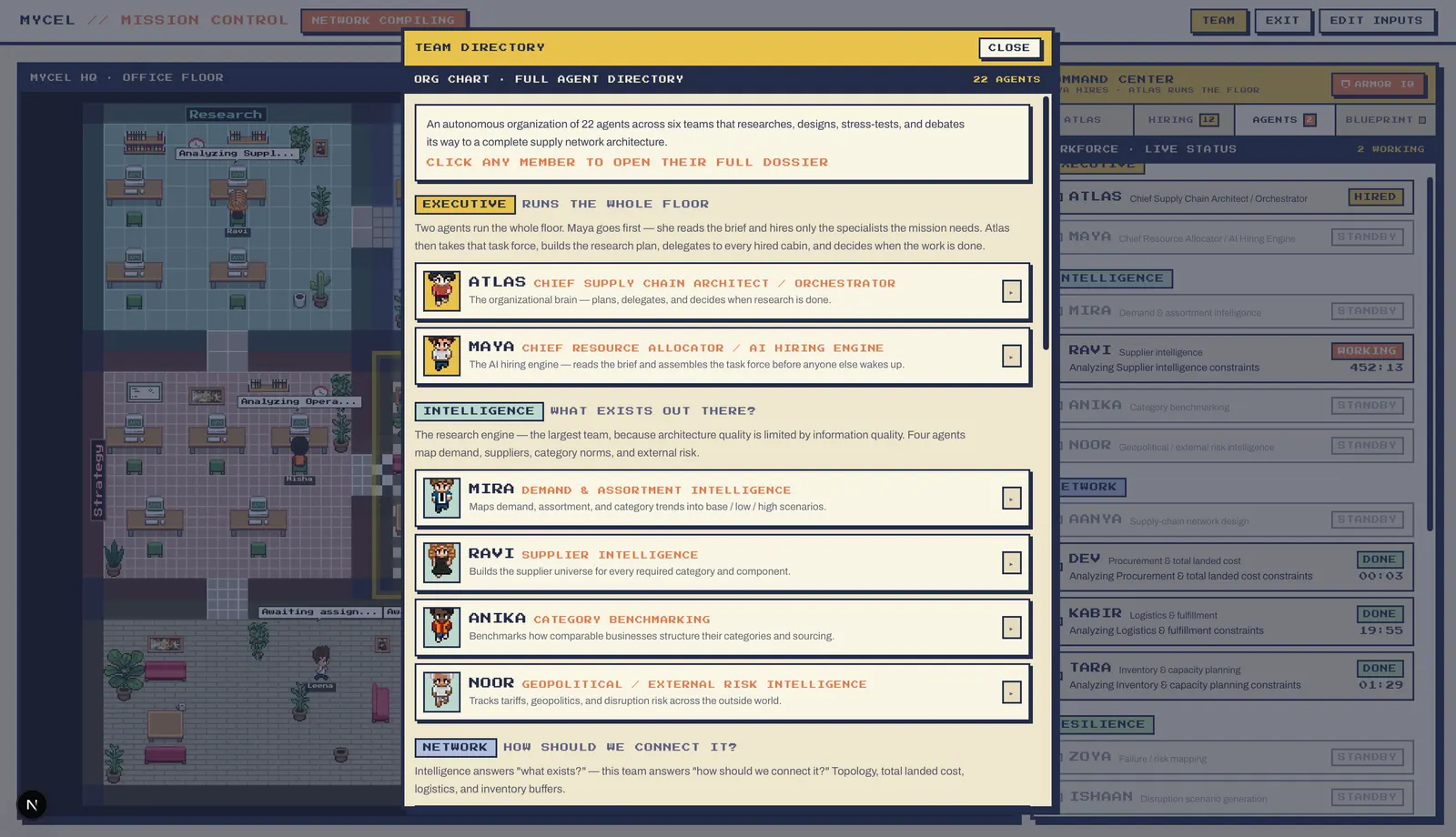
Mycel is an autonomous AI organisation for supply chains. You describe a business in plain language, and a Chief Resource Allocator hires the smallest team it needs from 22 specialist agents across six teams. They research suppliers, debate trade-offs in a four-round council, red-team the design and deliver an interactive supply network map. The blueprint then becomes a monitoring profile: when a tariff change or disruption threatens a node, Mycel re-architects the network on its own.
Why it exists
Supply chain software usually assumes you already know your supply chain in detail before it can help you. Mycel inverts that: start from a product idea and let an organisation of agents design a network that is grounded in evidence, stress-tested and still watched after it ships.
What the team built
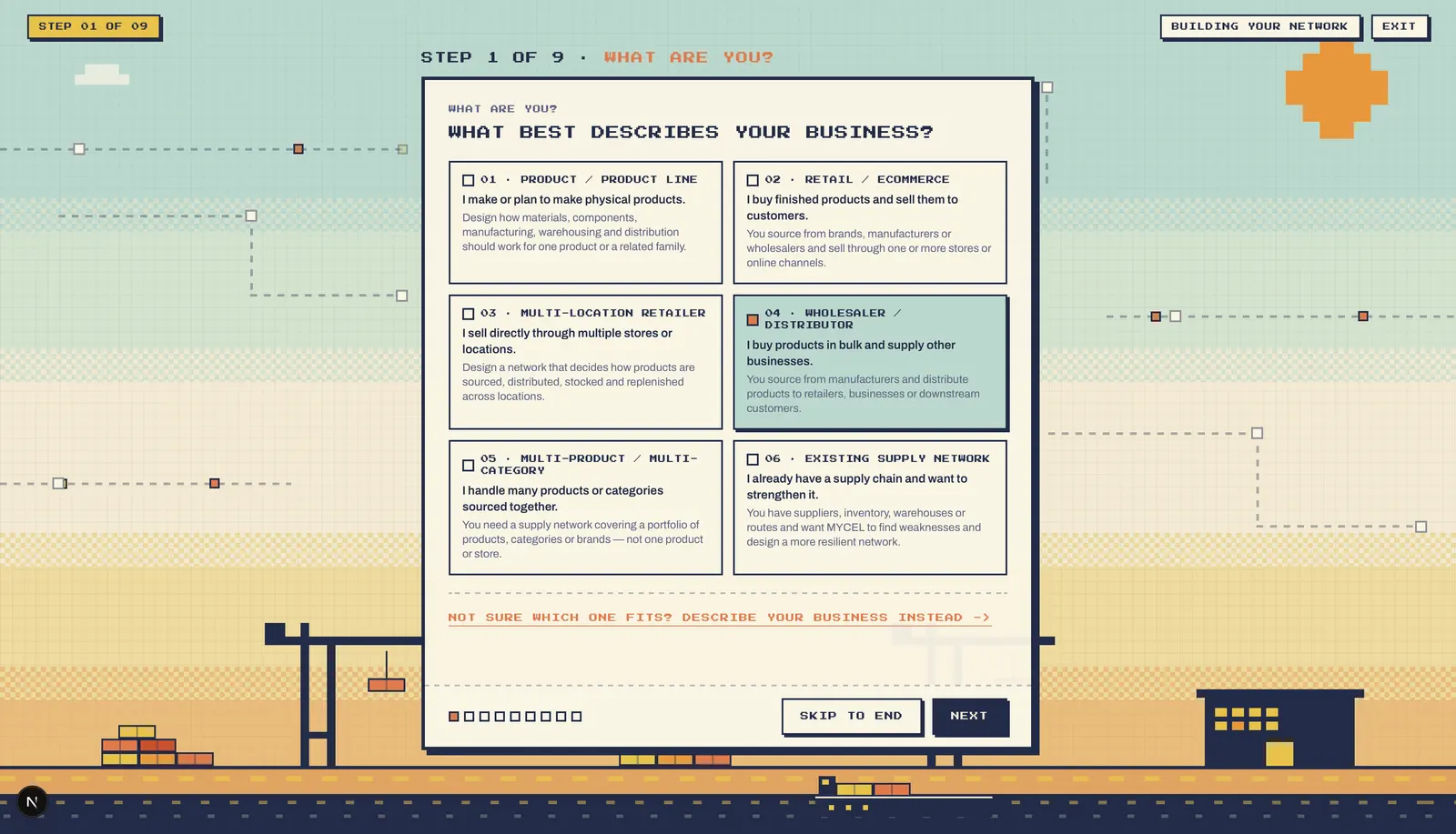
- A boot console with JWT operator login, and a nine-step intake wizard that collects the business archetype, products, geography, volumes, deadlines, cost tolerance, priorities and existing constraints, plus document upload (CSV, XLSX, PDF, DOCX) parsed into a FAISS index.
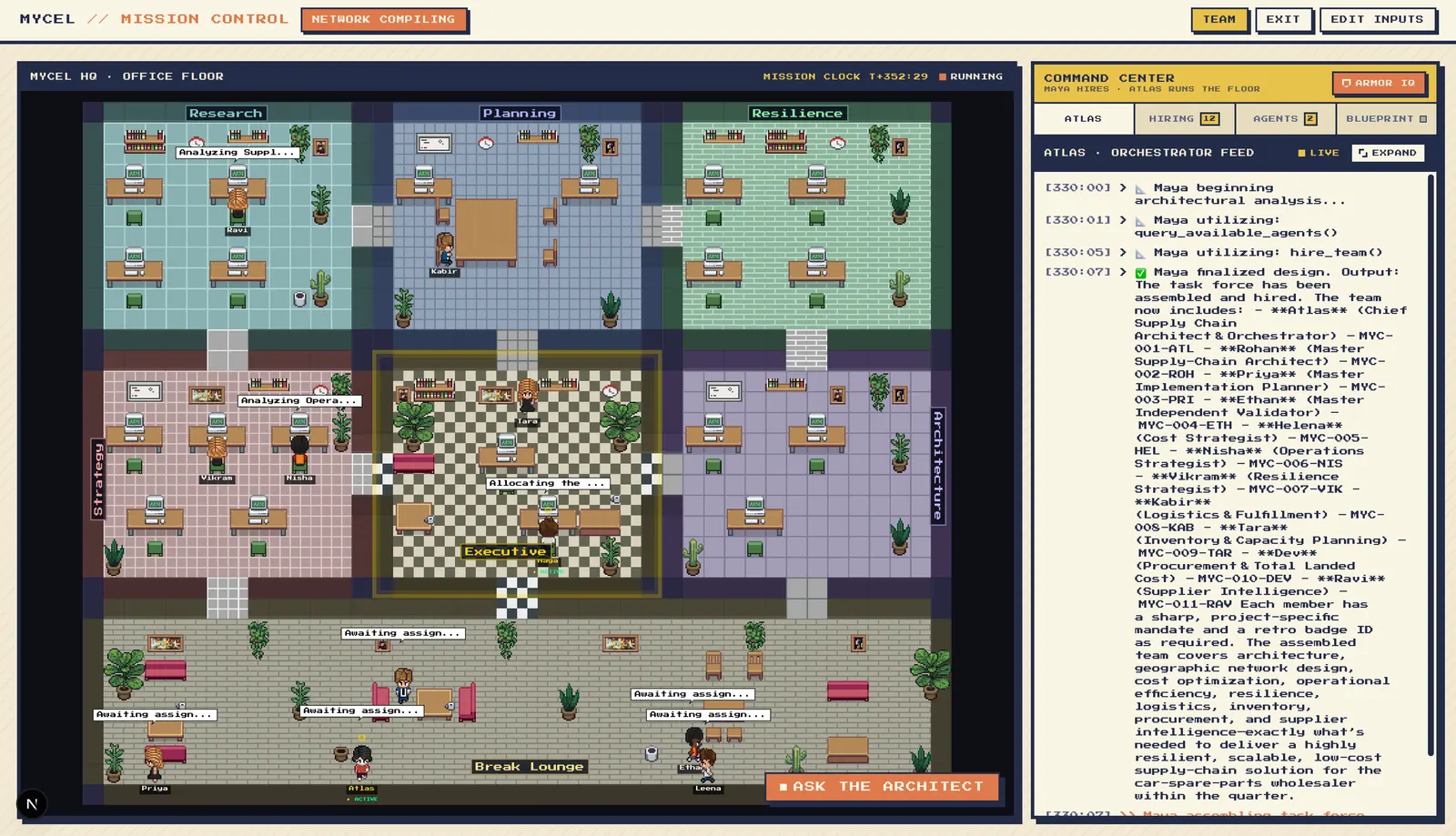
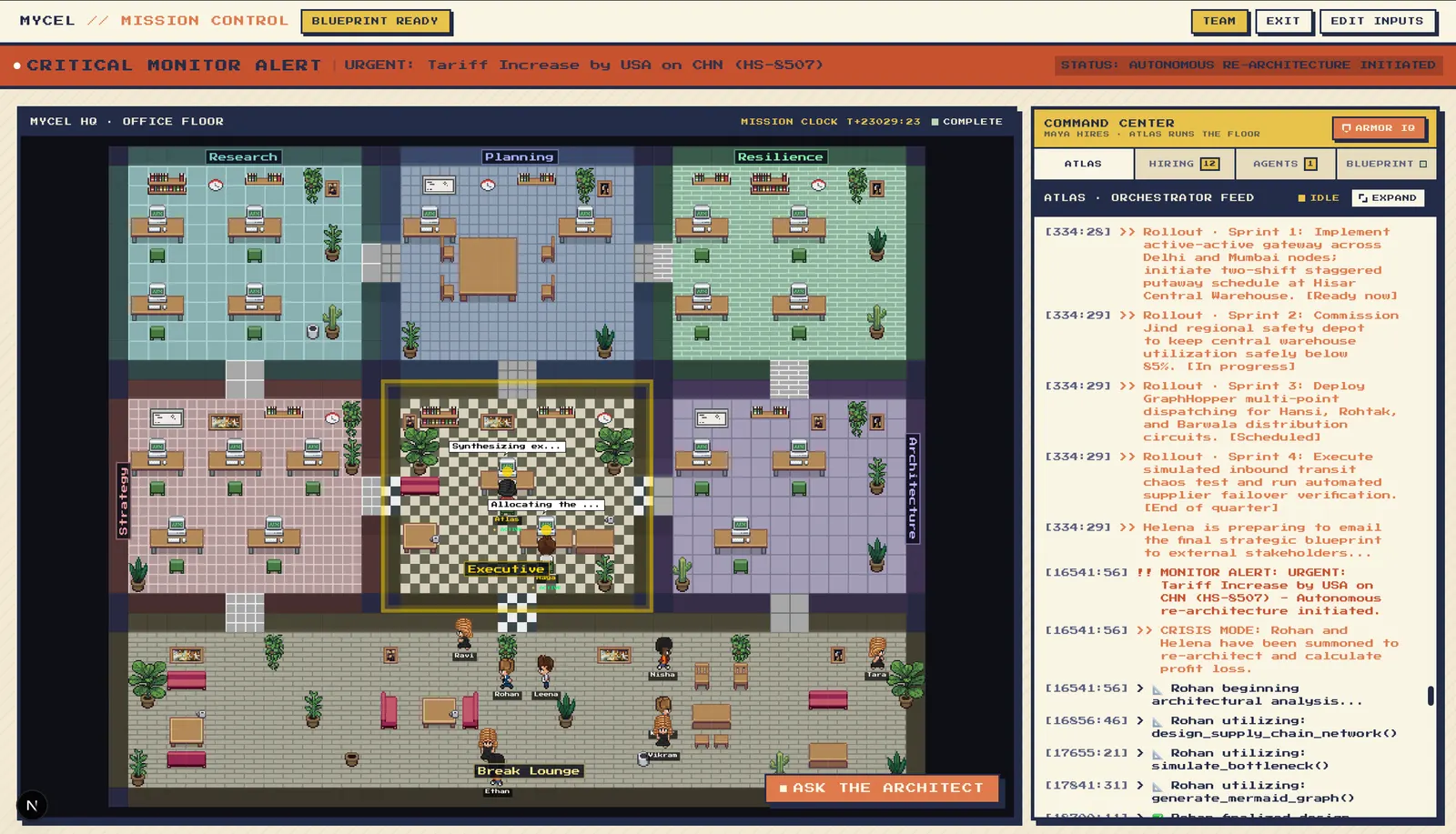
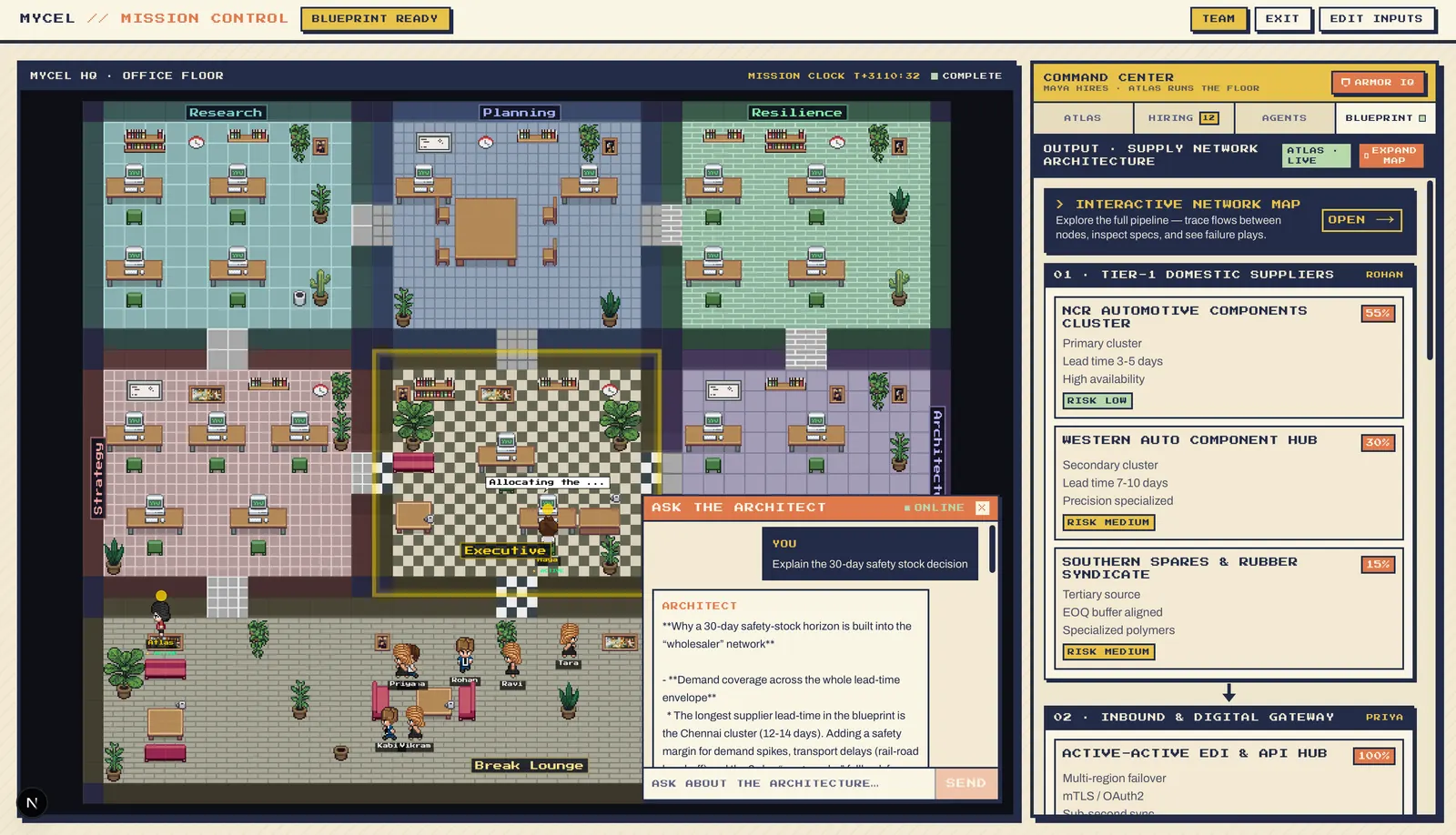
- Mission Control: a 60 fps HTML5 canvas pixel office where hired agents walk to their desks, with a live command center fed by the Atlas orchestrator over WebSockets.
- A four-phase pipeline in which Maya hires the minimum task force, the intelligence and network teams research and design, a red-team validator attacks single points of failure and a four-way council (cost, resilience, feasibility, compliance) decides.
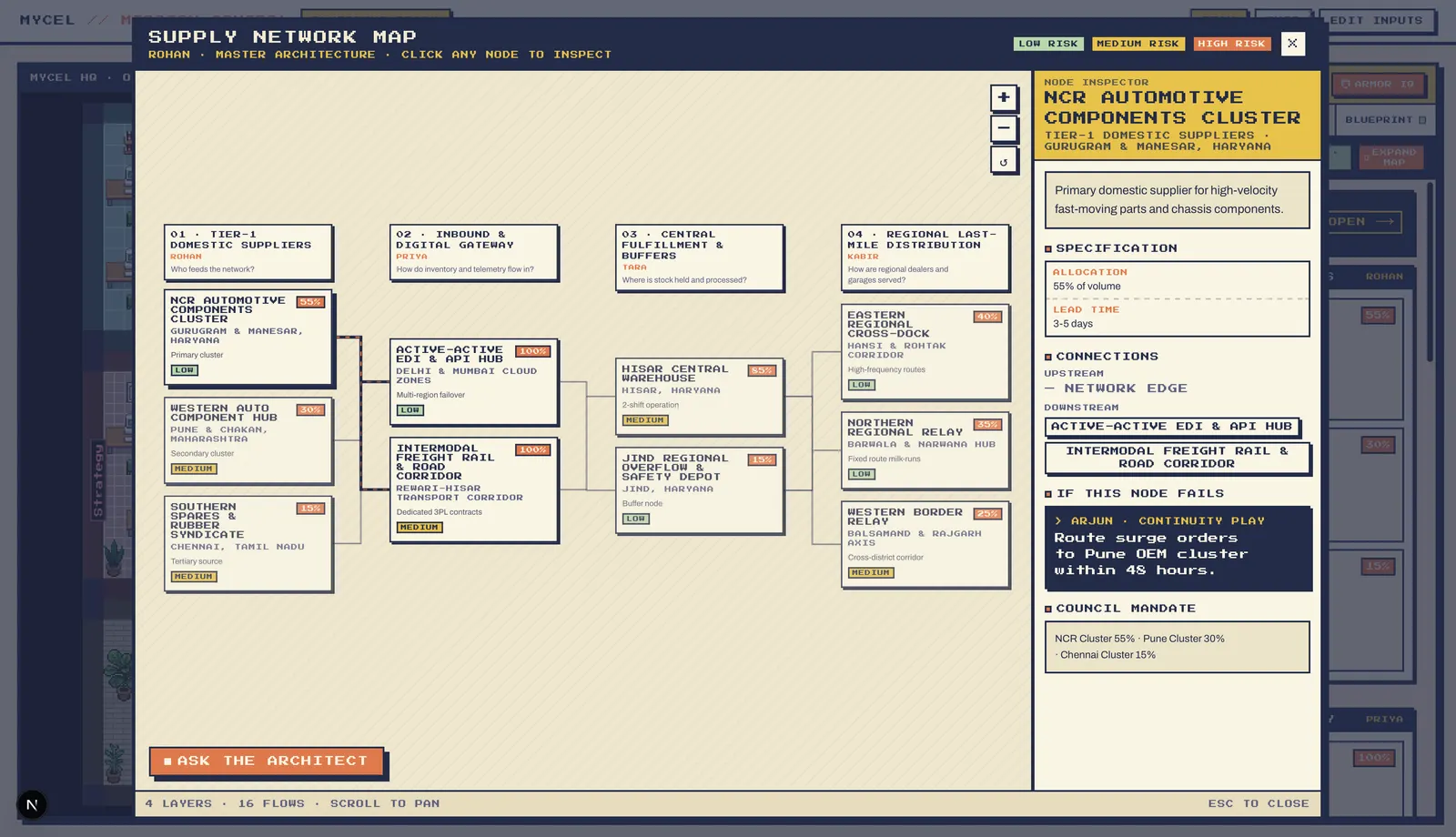
- An interactive multi-tier supply network map with a node inspector for allocation, lead time, risk and the recovery play if that node fails, and an 'Ask the Architect' RAG chat over the blueprint's own reasoning trace.
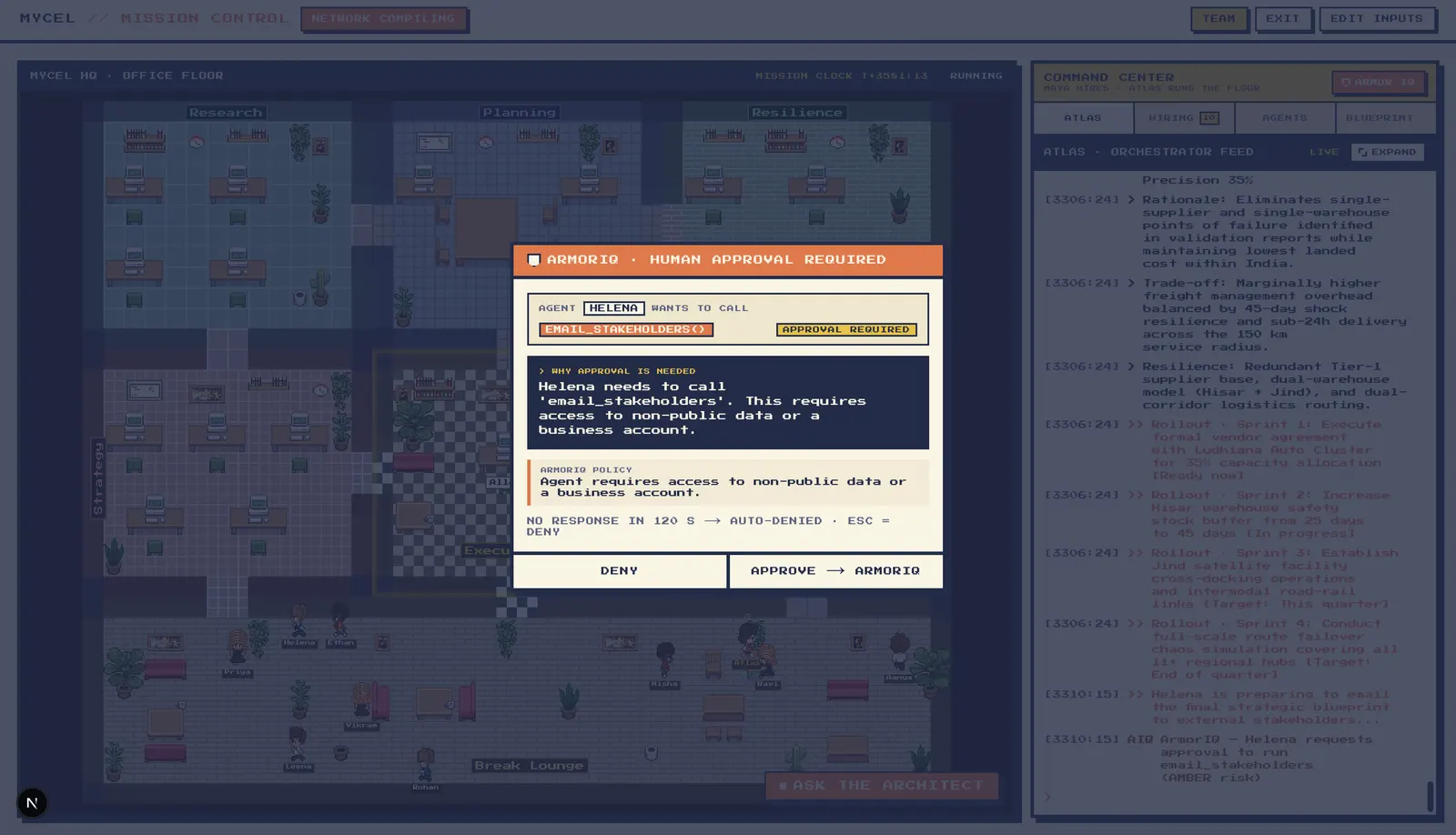
- An autonomous monitor across live data feeds that triggers crisis re-architecture, and ArmorIQ human-in-the-loop gating that sorts every agent tool call into autonomous, approval-required or blocked.
How it works
- a
Intake
Nine-step wizard and document ingestion compile a plain-language brief.
- b
Hire
Maya, the Chief Resource Allocator, hires only the agents this brief needs.
- c
Design
Intelligence and network teams research suppliers and draft the topology.
- d
Debate
A four-round council argues cost against resilience, feasibility and compliance.
- e
Monitor
The blueprint becomes a monitoring profile that re-routes the network when reality changes.
The product
Recognition
Chitkara University recognised and featured Mycel and the team on its official Instagram and LinkedIn pages.
View on LinkedInThe strategy council
Single agents tend to agree with themselves. Mycel forces disagreement: four seats argue for four different priorities over four rounds, and the chair decides with the trade-offs written down. Before sign-off a red-team validator attacks the design, and anything with an unmitigated single point of failure goes back to the council.
- HelenaCost minimisation
- VikramResilience
- NishaOperational feasibility
- OmarRegulatory compliance
Every supplier claim is tagged VERIFIED, ESTIMATED or UNKNOWN.
Built with
- Next.js
- React
- FastAPI
- MongoDB
- RabbitMQ
- Groq (Llama 3.3 70B)
- Gemini
- FAISS
- ArmorIQ
- HTML5 Canvas
- Agents
- 22 across 6 teams
- Pipeline
- 4 phases
- Council
- 4 adversarial seats
- Safety
- 3-tier human-in-the-loop gate
Status & next
Built inside a hackathon window. The team's write-up documents every agent, the phase contracts and the crisis re-architecture flow.
Source: mycel-final repository README and project write-up